
The short answer
Published inverter-only packages start at ₦1.49 million, while complete solar and inverter packages start at ₦2.35 million. The total depends on the equipment and loads selected from our Deye, Solis and Standard price charts.
We also design commercial and industrial projects of 1 MW and beyond. These custom systems are quoted separately after a site and load assessment.
Why prices are quoted in two parts
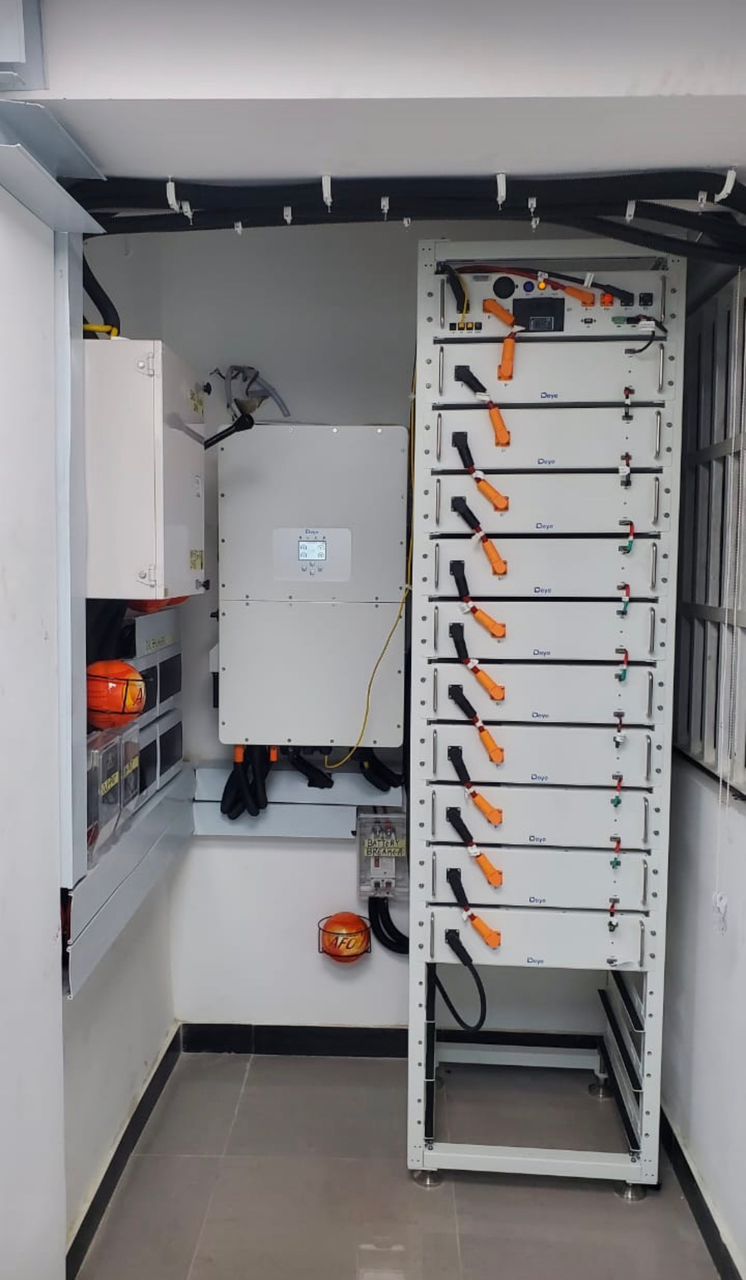
Almost every quote you receive in Nigeria splits into an inverter package and a solar package. The inverter package is the inverter, the lithium battery, cables, accessories and installation. The solar package is the panel array, its cables, accessories and installation.
This exists for a practical reason: many customers buy the inverter package first, which already ends the generator dependence for evenings and outages, and add the panel array a few months later. A 5 kVA inverter package is ₦2,820,000; the matching four-panel solar package is ₦1,120,000.
What actually drives your price
- Air conditioning. This is nearly always the deciding factor. A 1.5 HP AC draws around 1.25 kW while running and surges far higher on start-up.
- Refrigeration. Fridges and freezers run day and night and set your base load, which is what the battery has to carry.
- How long you need power. Bridging outages needs far less battery than running 24/7.
- Single-phase or three-phase. Estate residences and commercial buildings usually need three-phase inverters.
- Roof or ground mount. Where roof area or orientation is unsuitable, a ground-mounted array adds structure cost.
Is it cheaper than a generator?
Over the life of the system, comfortably. A generator has a lower purchase price and an unlimited running cost. A solar system is the reverse, concentrated upfront, then effectively free.
Our panels carry a 25-year warranty and our lithium batteries a 10-year warranty. A generator bought on the same day would typically have been replaced twice in that period, with fuel and servicing throughout.
How to find your own number
Write down every appliance you want running when the grid is off, note how many air conditioners and their horsepower, and decide whether you need overnight power or only outage cover. That list is all an engineer needs.
You can run it through our solar calculator for an indicative size, then check it against the published price charts.